Constitution
ARTICLE I NAME: The name of the association shall be the Honeoye Public Library.
ARTICLE II PLACE: It shall be located in Honeoye, Ontario County, New York.
ARTICLE III OBJECT: Its object shall be to maintain a circulating Library and reading
room, free, for public use.
ARTICLE IV MEETINGS: The annual meeting shall be held in January. Special
meetings may be called by the president, or any two of the
trustees.
ARTICLE V TRUSTEES: There shall be no less than seven (7) and no more than twenty
five (25) Trustees elected to serve. Trustees shall be elected
at the annual meeting to serve for five (5) years. The Trustees
shall elect from their own number to hold office for a year, a
president, vice-president, treasurer and secretary. Any
vacancy occurring during the term of the trustee shall be filled
until the next annual meeting by vote of the remaining
trustees.
ARTICLE VI POWERS & DUTIES OF THE OFFICERS: The trustees shall have the
general management of the Library and its property.
They shall provide ways and means for its maintenance
and endowment, suitable rooms, furniture, books and
serials, for its equipment, and make rules for its
convenient and free use by the public. They shall
appoint and fix the salary for a competent librarian and
of needed assistants and other employees. They shall
make by-laws, appoint needed committees and have such
other powers and duties as are prescribed for trustees of
public libraries by state law.
SECTION I The president shall preside at all meetings and conduct
them by formal order.
SECTION II The vice-president shall assume the powers and perform
the duties of the president in his/her absence.
SECTION III The secretary shall keep a record of all library meetings
and all official action of the trustees.
SECTION IV The treasure shall receive, hold and pay out the funds of
the library under the direction of the trustees.
SECTION V The librarian shall have charge of the library and its
operation under the direction of the trustees.
ARTICLE VII AMENDMENTS: Amendments to this constitution may be made by 4/7 vote
of the trustees.
Revised & approved 4/13/16
Bylaws
I OFFICERS: The officers shall be a president, vice president, treasurer
and secretary who shall be elected annually by the Board
from their own number.
The secretary shall record all official acts of the Board and
have custody of all of its official books, records and
documents except those in use by another officer.
The treasurer shall oversee all funds belonging to the
Library and keep the same in a separate account until paid
out. He/she shall be guardian of accurate accounts of
every receipt and expenditure, with the date, purpose and
amount and report the same at the annual meeting and
whenever required by the trustees.
II MEETINGS: There will be a minimum of four (4) meetings a year and
more as needed, at the Library. The annual meeting shall
be in January.
III LIBRARIAN: The librarian shall have immediate charge of the library and be responsible
for the care and safety of all materials and other library property: classify,
arrange and catalog all books, supervise the work of all other employees
and promptly report any delinquencies: keep accounts of all money received
from fines and other sources and pay all money to the treasurer or
bookkeeper. The librarian will report other matters requiring the attention of
the Board. He/she shall report in full at each meeting and discharge such
other duties that may be prescribed by the Board.
Reviewed & approved 1/6/88, 7/1/93, 5/27/98, 4/13/16
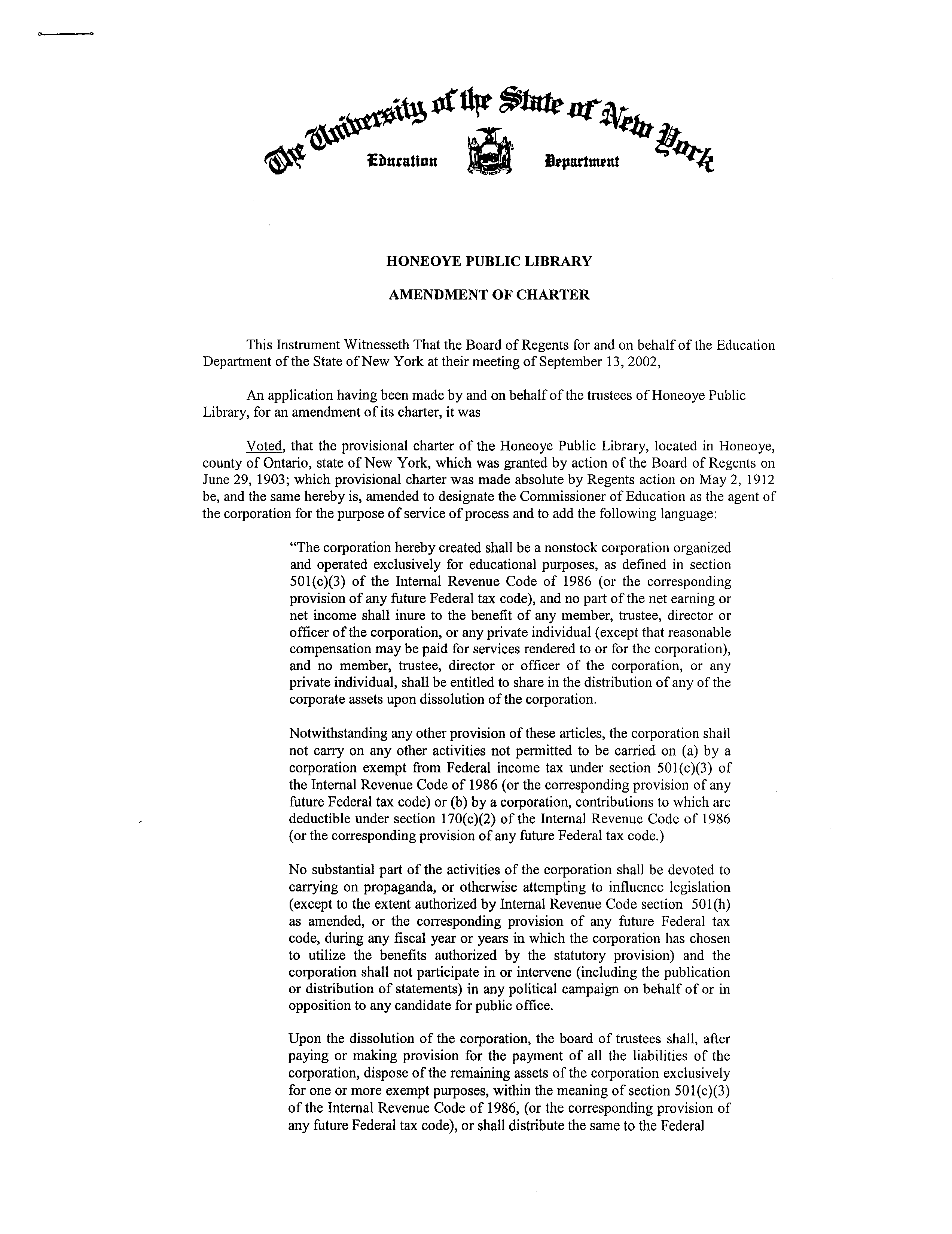
Amendment of Charter
Library Bill of Rights
The American Library Association affirms that all libraries are forums for information and ideas, and that the following basic policies should guide their services.
1. Books and other library resources should be provided for the interest, information and enlightenment of all people of the community the library serves. Materials should not be excluded because of the origin, background, or views of those contributing to their creation.
2. Libraries should provide materials and information presenting all points of view on current and historical issues. Materials should not be proscribed or removed because of partisan or doctrinal disapproval.
3 .Libraries should challenge censorship in the fulfillment of their responsibility to provide information and enlightenment.
4. Libraries should cooperate with all persons and groups concerned with resisting abridgment of free expression and free access to ideas.
5. A person’s right to use a library should not be denied or abridged because of origin, age, background, or views.
6. Libraries which make exhibit spaces and meeting rooms available to the public they serve should make such facilities available on an equitable basis, regardless of the beliefs or affiliations of individuals or groups requesting their use.
[Adopted June 18, 1948. Amended February 2, 1961, June 27, 1967, and January 23, 1980, inclusion of “age” reaffirmed January 23, 1996, by the ALA Council
Freedom to Read
7. It is in the public interest for publishers and librarians to make available the widest diversity of views and expressions, including those which are unorthodox or unpopular with the majority.
8. Publishers, librarians and booksellers do not need to endorse every idea or presentation contained in the books they make available. It would conflict with the public interest for them to establish their own political, moral or aesthetic views as a standard for determining what books should be published or circulated.
9. It is contrary to the public interest for publishers or librarians to determine the acceptability of a book on the basis of the personal history or political affiliations of the author.
10.There is no place in our society for efforts to coerce the taste of others, to confine adults to the reading matter deemed suitable for adolescents, or to inhibit the efforts of writers to achieve artistic expression.
11. It is not in the public interest to force a reader to accept with any book the prejudgment of a label characterizing the book or author as subversive or dangerous.
12. It is the responsibility of publishers and librarians, as guardians of the people’s freedom to read, to contest encroachments upon that freedom by individuals or groups seeking to impose their own standards or tastes upon the community at large.
13. It is the responsibility of publishers and librarians to give full meaning to the freedom to read by providing books that enrich the quality and diversity of thought and expression. By the exercise of this affirmative responsibility, they can demonstrate that the answer to a bad book is a good one, the answer to a bad idea is a good one.
[Adopted June 25, 1953; revised January 28, 1972, January 16, 1991, by the ALA Council and the AAP Freedom to Read Committee, July 12, 2000, and June 30, 2004.]
Freedom to View
14. To provide the broadest access to film, video, and other audiovisual materials because they are a means for the communication of ideas. Liberty of circulation is essential to insure the constitutional guarantee of freedom of expression.
15. To protect the confidentiality of all individuals and institutions using film, video, and other audiovisual materials.
16. To provide film, video, and other audiovisual materials which represent a diversity of views and expression. Selection of a work does not constitute or imply agreement with or approval of the content.
17. To provide a diversity of viewpoints without the constraint of labeling or prejudging film, video, or other audiovisual materials on the basis of the moral, religious, or political beliefs of the producer or filmmaker or on the basis of controversial content.
18. To contest vigorously, by all lawful means, every encroachment upon the public’s freedom to view.
[This statement was originally drafted by the Freedom to View Committee of the American Film and Video Association (formerly the Educational Film Library Association) and was adopted by the AFVA Board of Directors in February 1979. This statement was updated and approved by the AFVA Board of Directors in 1989.Endorsed January 10, 1990, by the ALA Council]